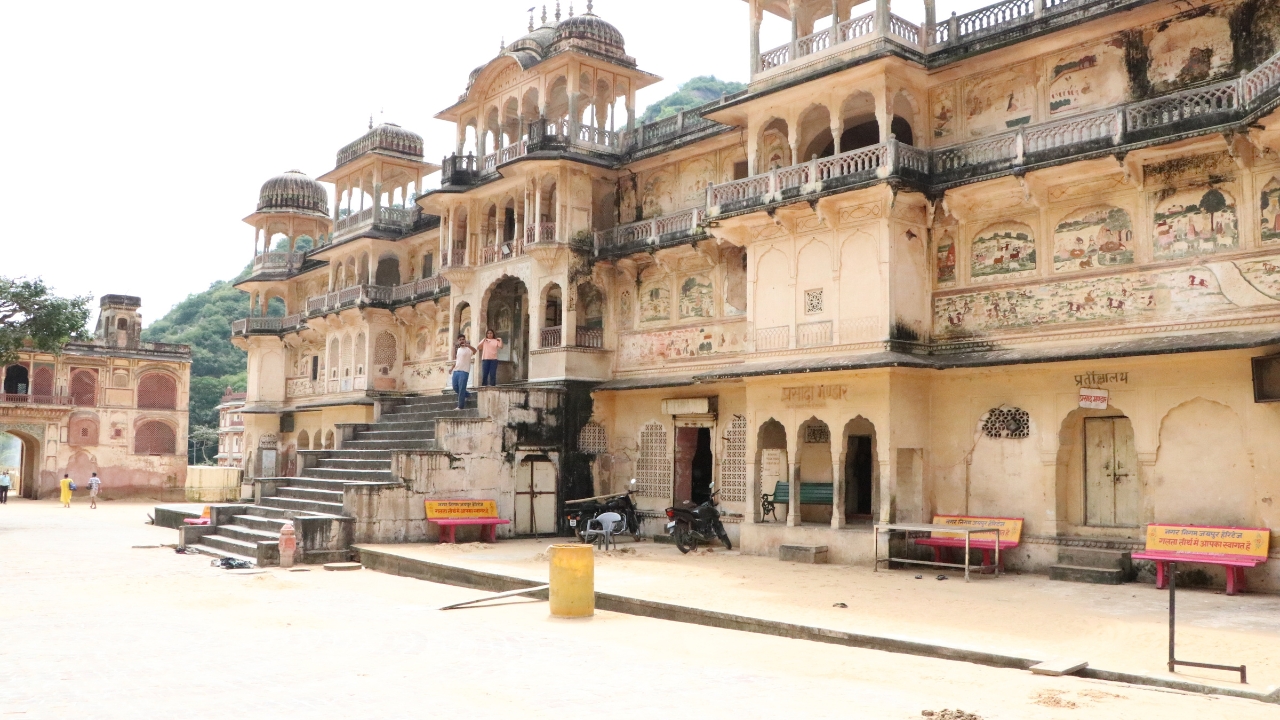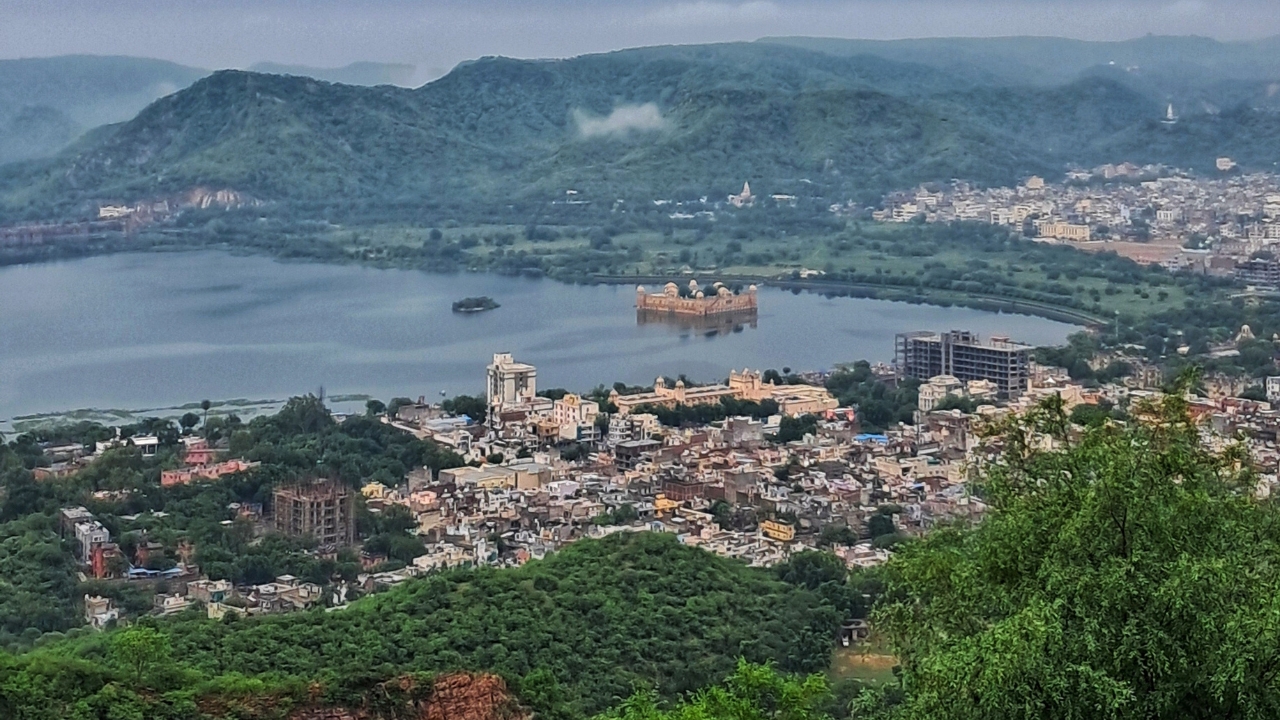
Nestled within a peaceful gorge of the ancient Aravalli hills, just 10 kilometres east of Jaipur city, Galtaji Temple is one of Rajasthan’s most spiritually alive and visually breathtaking destinations. Unlike most temples that stand as isolated structures, Galtaji is an entire sacred universe — a sprawling complex of temples, natural water tanks, forested hillsides, and centuries-old stone corridors, all woven together into one extraordinary pilgrimage site.
Popularly known as the Monkey Temple, the complex earns its nickname from the hundreds of rhesus macaques and langur monkeys that roam freely across its grounds. Here, they are not a nuisance — they are revered as living symbols of Lord Hanuman, treated with reverence by pilgrims and locals alike. Watching them bathe in the sacred kunds or leap across ancient sandstone walls is an experience unlike anything else in Jaipur.
Built entirely from the same warm pink sandstone that defines the Pink City itself, Galtaji blends seamlessly into its rocky, forested surroundings. The architecture is distinctly royal — ornate havelis, carved pillars, rounded domed pavilions, and painted corridors that feel more like a palace than a place of worship. This is Jaipur’s hidden gem: deeply sacred, wildly beautiful, and surprisingly off the tourist radar compared to the fort-heavy itineraries most visitors follow.
The origins of Galtaji go back far beyond the 18th-century structures that stand today. According to Hindu tradition, this valley was chosen by the revered sage Galav — from whom the site takes its name — as the place of his deep meditation and penance. Pleased by his devotion, the divine blessed the site with the gift of sacred waters, which continue to flow through a natural spring to this day. That flowing spring, emerging from a rock carved in the shape of a cow’s mouth, is the spiritual heartbeat of the entire complex.
The physical temple complex as we see it today was formally developed in the early 18th century by Diwan Rao Kriparam, a nobleman at the court of Maharaja Sawai Jai Singh II — the founder of Jaipur. Under royal patronage, the site was transformed from an ancient meditation ground into a grand complex of stone temples, sacred tanks, and richly painted interiors. The murals within the temples — executed in the traditional fresco style — depict scenes from Hindu mythology, royal court life, and seasonal festivals, and many remain remarkably preserved even today.
Over the centuries, Galtaji became an important pilgrimage centre for the Vaishnava tradition. Saints, ascetics, and devotees from across Rajasthan have made the journey to bathe in its sacred kunds and offer prayers at its temples. The site is also closely associated with the 15th-century Vaishnava saint Krishna Dasa Payahari, who is said to have meditated here — giving Galtaji a spiritual legacy that spans hundreds of years.
| Category | Fee |
| Indian Visitors | Free |
| Foreign Visitors | Free |
| Camera / Photography | Free |
Galtaji Temple is free to enter for all visitors. However, a small donation at the temple is always appreciated and goes toward the upkeep of the complex.
| Day | Timings |
| All Days (Temple) | 5:00 AM – 9:00 PM |
| Best Visiting Hours | 7:00 AM – 11:00 AM / 4:00 PM – 7:00 PM |
The temple is open every day of the year, including all public holidays and festivals. The complex is especially vibrant during Makar Sankranti, when thousands of pilgrims gather to take a holy dip in the kunds.
October to March is the ideal window to visit Galtaji Temple. The weather is cool and pleasant, making the uphill walk comfortable, and the surroundings are at their most photogenic with clear skies and golden light playing on the pink sandstone.
Best time of day: Early morning between 7–10 AM for a peaceful, crowd-free experience and beautiful light. Late afternoon (4–6 PM) is wonderful for spotting the monkeys at their most active.
The complex is home to hundreds of rhesus macaques and langur monkeys that roam freely throughout the premises. They are considered sacred — seen as devotees of Lord Hanuman — and are fed and cared for by the temple priests and local visitors daily.
Yes, entry to Galtaji Temple is completely free for all visitors, both Indian and foreign nationals. There are no ticket counters or entry charges.
The monkeys are habituated to human presence and are generally harmless. However, avoid carrying visible food items, do not tease or make sudden movements near them, and keep a watchful eye on bags, sunglasses, and phones — monkeys are curious and quick.
Yes, the sacred kunds are open for bathing by pilgrims. The Galta Kund is the most popular for ritual bathing. Carry a change of clothes if you plan to bathe.
There is no strict formal dress code, but as with all Hindu temples, modest clothing is appreciated. Remove footwear before entering any temple shrine within the complex.
Allow 1.5 to 2.5 hours to comfortably explore the full complex — the kunds, the main temples, the Gaumukh, and the Sun Temple viewpoint at the top.
The lower sections of the complex — including the main kunds and temples — are accessible and comfortable for elderly visitors and children. The climb to the Sun Temple at the top is steeper and requires reasonable fitness.
Makar Sankranti is the most important festival at Galtaji. Thousands of pilgrims gather from across Rajasthan to take a holy dip in the sacred kunds, believing that bathing here on this day brings immense spiritual merit and washes away all sins.
Local guides can be arranged through Jaipur Tour Planner to help you understand the temple’s rich mythology, architecture, and history — transforming a simple visit into a deeply enriching experience.
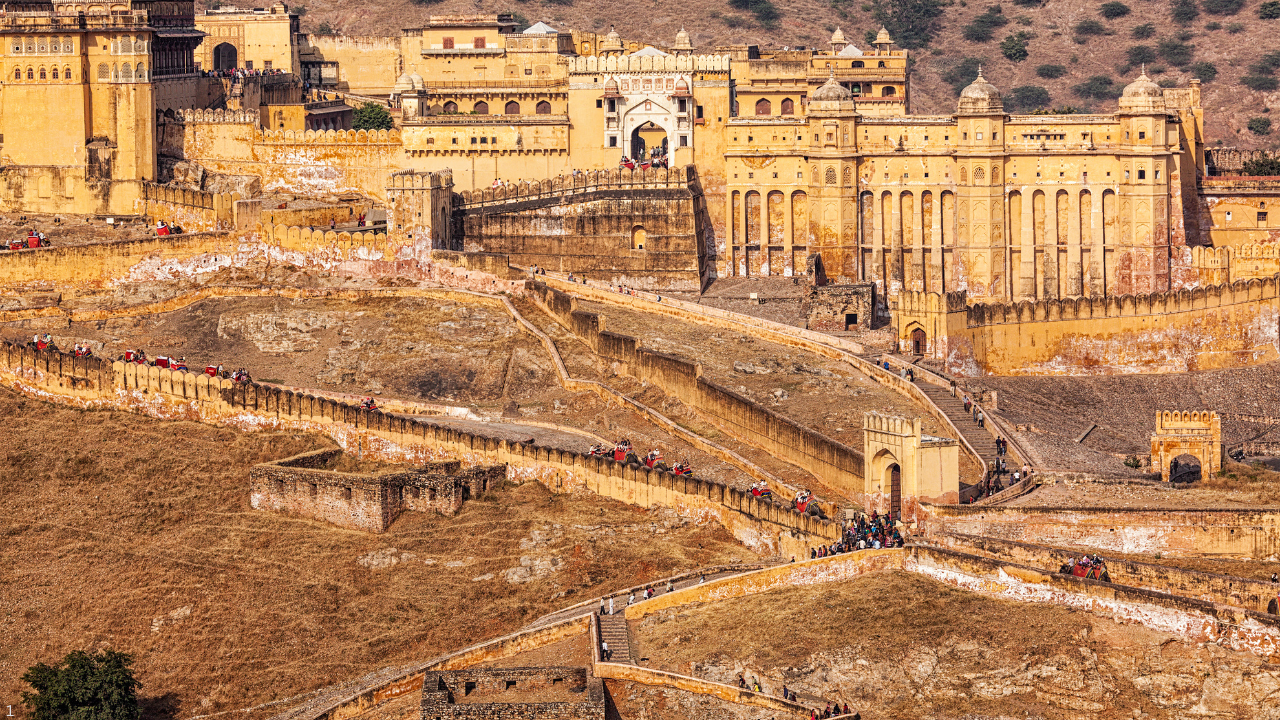
Absolutely. Jaipur Tour Planner recommends combining Galtaji with Amer Fort, Jaigarh Fort, and Sisodia Rani Garden for a full day of culture, history, and nature — all located within easy reach of each other.
Address: Galta Road, Khaniyon Ka Rasta, Brahmpuri, Jaipur, Rajasthan – 302002

Nothing Match your search terms. Please try again with some different keywords.